Field method / Tools of observation

ROV & Field
Equipment

A camera under water and a scanner on dry ground answer different parts of the same question: what is actually there?

Meet the field tools
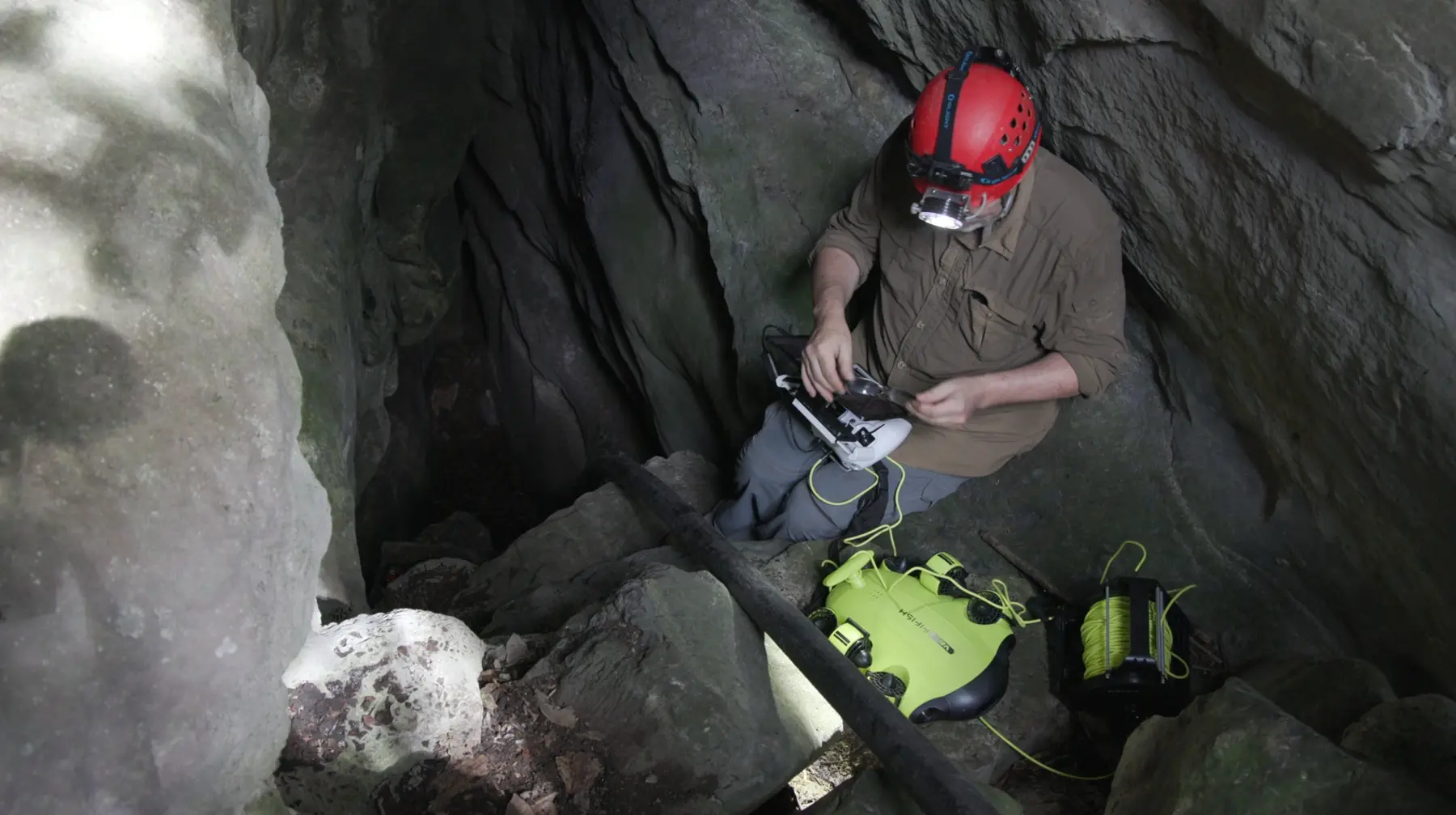
Michael Girard preparing a bright yellow underwater ROV and tether among rocks in a cave
Preparing Robo-Teddy in Sistema Calera. Photo: Mike Sandone.

01 / Current underwater vehicles

Across the waterline.

The FIFISH V6 and V6s are Michael's primary remotely operated underwater vehicles (ROVs). Lights, cameras, maneuvering thrusters, and a tether let him inspect a flooded space while keeping its geometry, obstructions, and return route in view.

QYSEA / FIFISH

V6

The compact six-thruster vehicle brings a 4K camera and lights into dark water. Its ability to hold attitude and move in several directions matters in a passage where the ceiling, floor, and sidewalls all constrain the route.

Field role
Underwater observation and filming
What it brings back
Video of passage, structure, and context
QYSEA / FIFISH

V6s

The V6s adds a larger battery and an attachment port with a robotic claw. That gives the team more operating time and the option to handle an object when the site and research plan make that appropriate.

Field role
Extended inspection and careful manipulation
What changes
Longer working time and a small gripper

02 / Why a second vehicle matters

The day the V6 stopped.

On a 2021 mine visit with Mike Sandone, Michael's V6 shut down just as the team lowered it into a flooded stope. They retrieved a backup OpenROV Trident and completed a run, but the difference in maneuverability, lighting, and footage made the work harder.

That experience led Michael to add the V6s. A backup is part of the field method when the journey underground is long and the opportunity to document a passage may be brief. The tether, launch position, spare vehicle, and people managing them are as consequential as the camera itself.

How the method developed ↗

03 / Mapping dry spaces

3DMakerpro
Raven LiDAR

Handheld spatial scanner / New addition

Michael has also added a 3DMakerpro Raven LiDAR scanner. It is for recording the shape of accessible, dry spaces as a three-dimensional point cloud. That could help document the relationships among a cave passage, mine working, entrance, or surface feature.

The Raven complements the underwater ROVs; it is not an underwater vehicle. Its place in Michael's field practice is still developing, so this page does not present a completed Raven survey or a measurement from one.

Raven manufacturer information ↗

04 / Earlier vehicles and ideas

What came before.

Earlier tools remain in the story because each made a later choice clearer.

OpenROV 2.8

An open-source, adaptable small ROV from Michael's earlier equipment archive. It provided a platform for learning, experimentation, and underwater camera work.

OpenROV Trident

A sturdier, streamlined successor that served as the backup on the 2021 mine visit. It completed the run after the V6 failed, even though the footage and piloting were more difficult.

A dry-passage robot

In 2023 Michael described testing a quadruped development kit for narrow or unstable dry passages. That article was a proposal for trials, not a report that a field-ready robot had joined the fleet.

In the field

A tool extends a question.

The equipment records what its sensors can reach. The observations become useful when they are tied to a place, a route, a field note, and the people able to test an interpretation.

Schoharie ROV drop ↗Sistema Calera ↗

Sources & credits

This overview condenses Michael Girard's former “Underwater Drones,” FIFISH V6, FIFISH V6S, OpenROV Trident, OpenROV 2.8, “New Underwater ROV” (2021), and “Robot Exploration” (2023) pages, together with his current equipment update. The old specification lists described models and configurations at the time; this page focuses on field roles rather than repeating every manufacturer rating.

The Raven description follows 3DMakerpro's product documentation ↗. The field photograph is by Mike Sandone and is also listed in the image credits.

All expeditions ↗