Expedition record / Connecticut
Wolf-Hollow
Ice Cave
An old account of ice in a shaded gorge led Michael back to a cave the landscape had nearly hidden.
Read the field record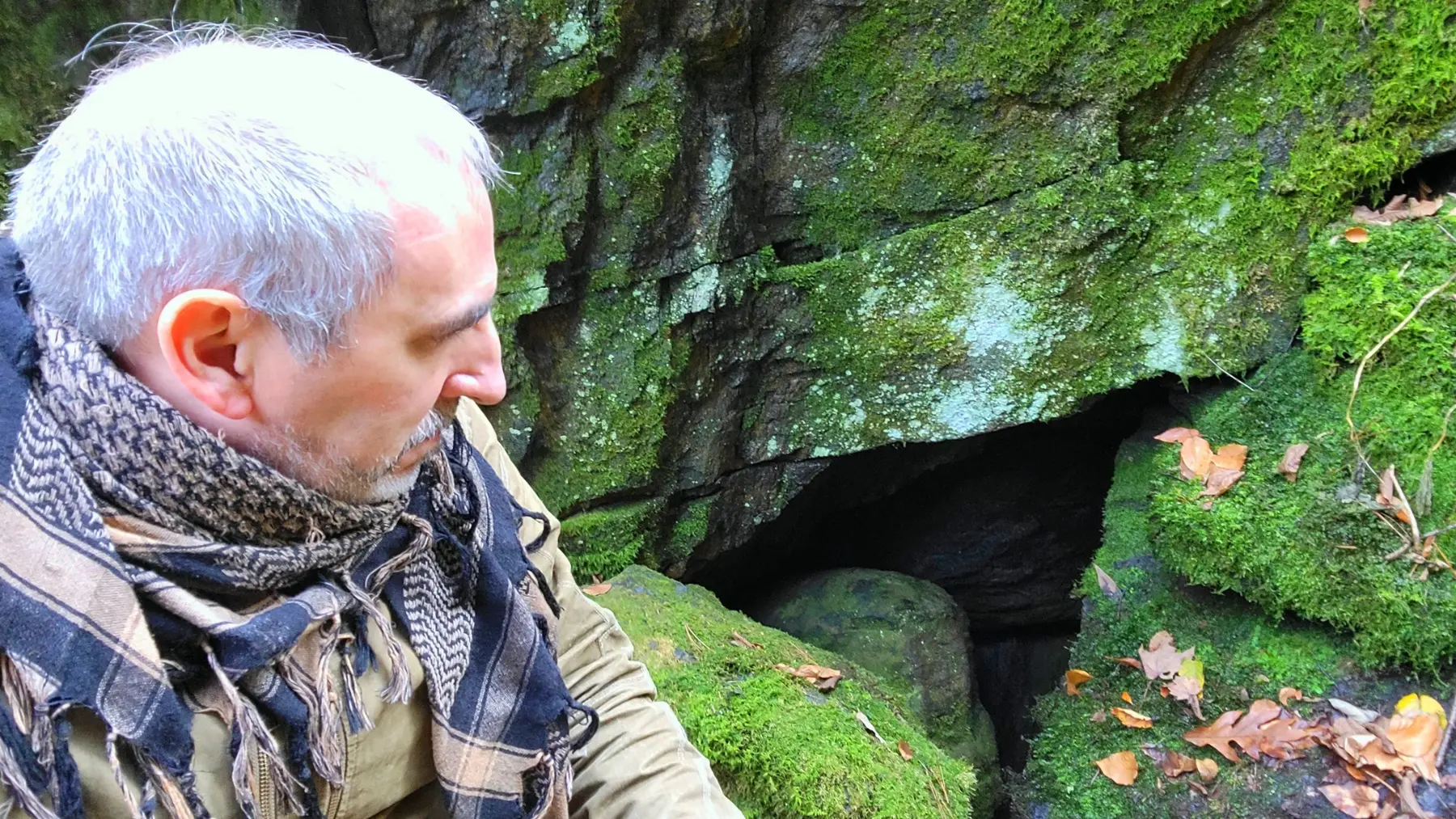
01 / A place in the old record
Following a colder clue.
Historical writers described a cave at “Wolfshollow” where snow and ice could remain well after winter. Edwin Swift Balch included the account in his 1900 study of freezing caverns, citing an 1824 description by C. A. Lee. The report gave Michael a question to carry into the field: what kind of place could hold winter so far into the year?
In late 2021, Michael located Wolf-Hollow Ice Cave again. A narrow opening lay among fractured, moss-covered rock within a steep gorge. The visit connected a real cave and landscape to the historical descriptions. It did not, by itself, establish how long ice now lasts there.
02 / Reading the terrain
Where winter
might linger.
The gorge is deep and shaded, with broken stone around the cave. Michael's earlier account suggested that cold winter air may settle into openings among the rock, chilling the talus beneath. Limited sunlight and the mass of cold stone could then slow warming when the forest outside turns green. Water entering those cold spaces might freeze or remain frozen for a time.
That is an explanation to test, not a measured result from this visit. The historical report of persistent ice, the cave Michael found, and the proposed airflow mechanism are different kinds of evidence. Repeated observations and temperature measurements across seasons would show how closely the cave's present behavior matches its reputation.
What remains
A cave with two histories.
Wolf-Hollow belongs both to the history of people trying to explain natural ice caves and to the field record of places that can disappear from ordinary notice. Finding the opening renewed the question. The seasonal pattern inside it remains a subject for future observation.
Another historical cave search ↗Sources & credits
Field identification and landscape interpretation follow Michael Girard's earlier Wolf-Hollow account and expedition summary. The cave photograph is by Michael Girard; see the image credits. No precise access directions are provided.
Historical references: C. A. Lee, “Geology and Mineralogy of Salisbury, Con.,” The American Journal of Science and Arts, vol. 8 (1824) ↗; and Edwin Swift Balch, Glacières; or, Freezing Caverns (1900) ↗. The historical report of ice lasting through much of the year is not presented as a current field measurement.